Customization
Styling chart
Apply custom CSS classes to change chart appearance.
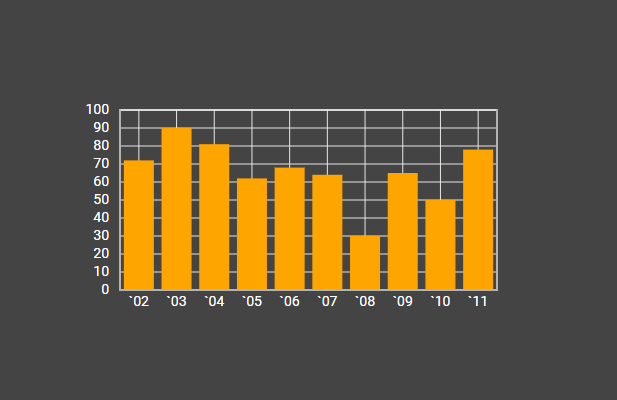
Related sample: Chart. Styling (custom CSS)
Follow these steps:
- Add one or more CSS classes in the
<style>section of your HTML page or in a separate stylesheet linked on the page:
<style>
    .my_first_class {
        /*some styles*/
    }

    .my_second_class {
        /*some styles*/
    }
</style>
- Assign the class name (or several names separated by spaces) to the css property:
const chart = new dhx.Chart("chart_container", {
    css: "my_first_class my_second_class"
});
For example:
<style>
    .custom {
        --dhx-background-primary: #444;
        --dhx-font-color-secondary: #fff;
    }
    .custom .chart.bar {
        fill: orange;
    }
</style>

<script>
    const chart = new dhx.Chart("chart_container", {
        type: "bar",
        css: "custom dhx_widget--bordered",
        scales: {
            "top": {
                size: 100
            },
            "bottom": {
                text: "month", size: 100
            },
            "left": {
                size: 100, maxTicks: 10, max: 100, min: 0
            },
            "right": {
                size: 100
            }
        },
        series: [
            {
                id: "A", value: "company C", color: "#5E83BA",
                pointType: "circle", fill: "#5E83BA", size: 35
            }
        ]
    });
</script>
Adding template to scale labels
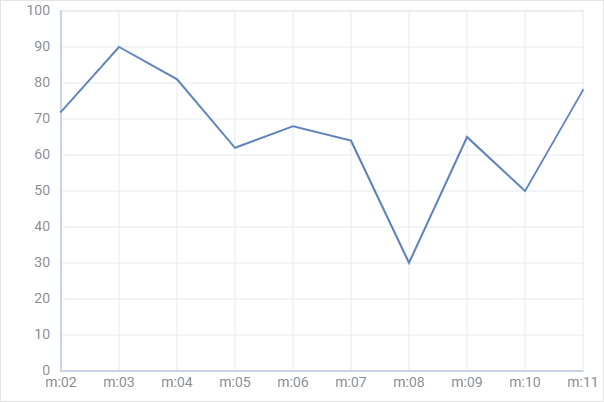
Related sample: Chart. Text template for scale labels
Set the textTemplate option of scales to add a template for scale labels:
const chart = new dhx.Chart("chart_container", {
    type: "line",
    css: "dhx_widget--bg_white dhx_widget--bordered",
    scales: {
        "bottom": {
            text: "month",
            textTemplate: function(month) {
                return "m:" + month;
            }
        },
        "left": {
            maxTicks: 10, max: 100, min: 0
        }
    },
    series: [
        {
            id: "A", value: "company C", color: "#5E83BA", strokeWidth: 2
        }
    ]
});
Adding color gradient for bars
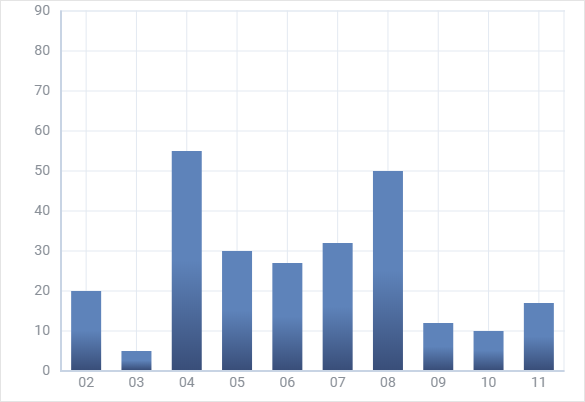
Related sample: Chart. Bar chart. Gradient
Use the gradient option of series to define a color gradient for bars. Set it to a function that takes the series fill color as a Hex string:
const chart = new dhx.Chart("chart_container", {
    type: "bar",
    css: "dhx_widget--bg_white dhx_widget--bordered",
    scales: {
        "bottom": {
            text: "month",
        },
        "left": {
            max: 90
        }
    },
    series: [
        {
            id: "A", value: "company A", color: "none", size: 35,
            fill: "#5E83BA",
            gradient: function(color) {
                return {
                    stops: [
                        {
                            offset: 0.5,
                            color: color,
                            opacity: 1
                        },
                        {
                            offset: 1,
                            color: "#394E79",
                            opacity: 1
                        }
                    ]
                }
            }
        }
    ]
});
Setting bar colors dynamically
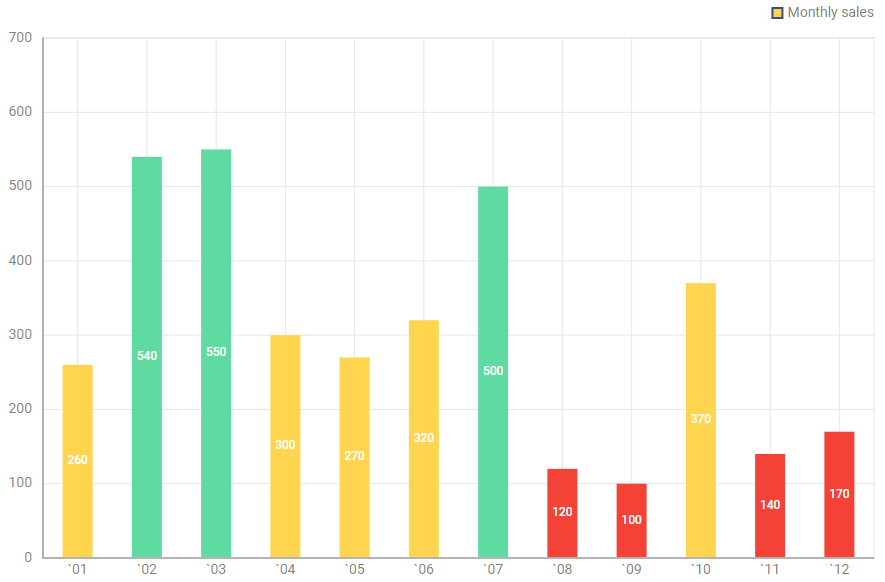
By default, all bars of a series have the same color. To color each bar by its data, set the fill option of series as a function. The chart calls the function with a data item, and the function returns the fill color of the bar that displays it:
const plan = 500;
const minimum = 250;

const chart = new dhx.Chart("chart_container", {
    type: "bar",
    scales: {
        "bottom": {
            text: "month"
        },
        "left": {
            max: 700
        }
    },
    series: [
        {
            id: "sales",
            label: "Monthly sales",
            value: "company A",
            fill: function(item) {
                if (item["company A"] >= plan) {
                    return "#5FDAA0";
                }
                return item["company A"] >= minimum ? "#FFD54F" : "#F44336";
            },
            color: "#394E79",
            showText: true
        }
    ],
    legend: {
        series: ["sales"],
        halign: "right",
        valign: "top"
    }
});
Related sample: Chart. Dynamic colors. Conditional fill by value
You can also set the color option as a function. The chart calls it with a data item, and the function returns a color. If you set only color (and don't set fill), its value colors the bars as well. If you set both options, the bars take the color that fill returns.
Related sample: Chart. Dynamic colors. Highlight highest and lowest
Details on how the chart applies the colors:
- The chart calls the
fillorcolorfunction for each bar. When the data changes, the chart calls the function again and repaints the bars. - The legend marker takes the color that the function returns for the first data item, so it doesn't reflect the other bar colors.
- In a stacked chart, each series applies its own
fillandcolor, so one series can use a function while another uses a fixed color. - The chart calls the
gradientfunction once for each distinct color thatfillreturns, so bars that share a color also share a gradient (see the Chart. Dynamic colors. Gradient fill sample).
Only Bar and X-Bar charts accept a function in fill and color. Line, Spline, Area, SplineArea, Radar and Scatter charts draw a series as a single shape and throw a TypeError if you set fill or color as a function.
Adding template to tooltips
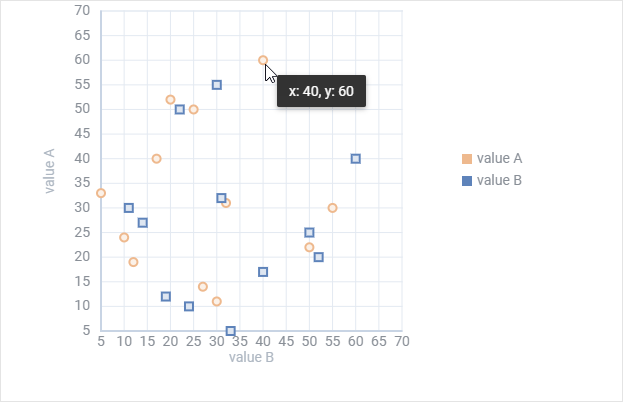
Related sample: Chart. Tooltip template
Set the tooltipTemplate option of series to define how data item values appear in a tooltip:
function tooltipTemplate(p) {
  return "x: " + p[1] + ", y: " + p[0];
};

const chart = new dhx.Chart("chart_container", {
    css: "dhx_widget--bg_white dhx_widget--bordered",
    scales: {
        bottom: {
            locator: "value B", title: "value B", max: 70
        },
        left: {
            title: "value A", max: 70
        }
    },
    series: [{
        id: "A", type: "scatter", value: "value A", valueY: "value B",
        pointType: "circle", color: "#EEB98E",
        tooltipTemplate: tooltipTemplate
    },
    {
        id: "B", type: "scatter", value: "value B", valueY: "value A",
        pointType: "rect", color: "#5E83BA",
        tooltipTemplate: tooltipTemplate
    }],
    legend: {
        series: ["A", "B"],
        usePointType: true,
    }
});
Adding template to text values of data items in bars
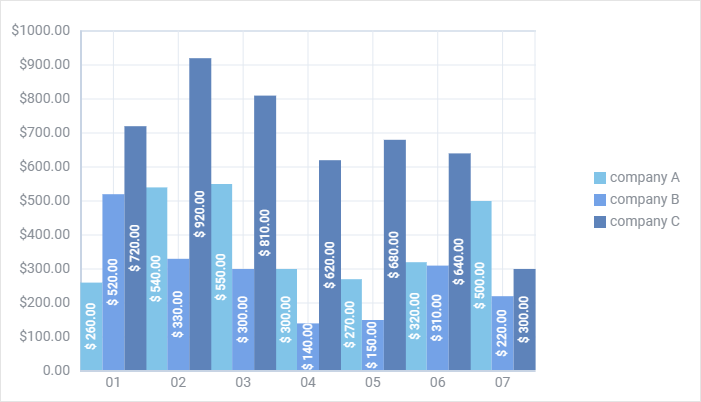
Related sample: Chart. Show text
The showTextTemplate option of series formats the values that appear on bars:
const chart = new dhx.Chart("chart_container", {
    type: "bar",
    css: "dhx_widget--bg_white dhx_widget--bordered",
    scales: {
        bottom: {
            text: "month"
        },
        left: {
            max: 1000, maxTicks: 10, min: 0,
            textTemplate: function (cost) {
                return cost !== 0 ? "$" + cost + ".00" : cost + ".00"
            }
        }
    },
    series: [
        {
            id: "A", value: "company A", color: "#81C4E8", fill: "#81C4E8",
            showText: true,
            showTextRotate: -90,
            showTextTemplate: function (sum) {
                return "$ " + sum + ".00";
            },
            barWidth: 22, tooltip: false
        },
        {
            id: "B", value: "company B", color: "#74A2E7", fill: "#74A2E7",
            showText: true,
            showTextRotate: "-90",
            showTextTemplate: function (sum) {
                return "$ " + sum + ".00";
            },
            barWidth: 22, tooltip: false
        }
    ],
    legend: {
        series: ["A", "B"],
        halign: "right",
        valign: "middle"
    }
});
Adding template to values of data items in Pie and Donut charts
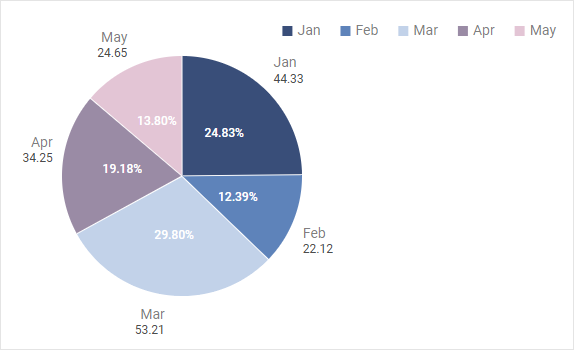
Related sample: Chart. Value template
The valueTemplate option of series formats the values displayed on Pie, Pie3D, and Donut charts. For example:
const chart = new dhx.Chart("chart_container", {
    type: "pie",
    series: [
        {
            value: "value",
            valueTemplate: value => {
                return (value * 100).toFixed(2) + "%";
            }
        }
    ]
});