Integration with Vue
This guide assumes familiarity with Vue concepts and patterns. For background, see the Vue 3 documentation.
DHTMLX Kanban is compatible with Vue. The full code example for Vue 3 is available on GitHub.
Create a project
Install Node.js before creating the project.
The following command creates a new Vue project:
npm create vue@latest
The command runs create-vue, the official Vue project scaffolding tool. For details, see the Vue.js Quick Start.
Name the project my-vue-kanban-app.
Install dependencies
Move into the app directory:
cd my-vue-kanban-app
Install dependencies and start the dev server with one of the package managers:
- For yarn:
yarn
yarn start // or yarn dev
- For npm:
npm install
npm run dev
The app runs on a localhost address (for example, http://localhost:3000).
Create Kanban
Stop the dev server and install the Kanban package.
Step 1. Install the package
Download the trial Kanban package and follow the steps in the README file. The trial version is available for 30 days.
Step 2. Create the component
Create a Vue component that mounts Kanban and the Toolbar. Add a new Kanban.vue file to the src/components/ directory.
Import source files
Open Kanban.vue and import the Kanban source files. The import paths depend on the package version:
- For the PRO version installed from a local folder:
<script>
import { Kanban, Toolbar } from 'dhx-kanban-package';
import 'dhx-kanban-package/dist/kanban.css';
</script>
If the package ships minified source files, import the CSS file as kanban.min.css.
- For the trial version:
<script>
import { Kanban, Toolbar } from '@dhx/trial-kanban';
import '@dhx/trial-kanban/dist/kanban.css';
</script>
This tutorial uses the trial version of Kanban.
Set up containers and initialize Kanban
To display Kanban with the Toolbar, create two containers and call the constructors. The following code snippet wires up refs and instantiates the components inside mounted():
<script>
import { Kanban, Toolbar } from "@dhx/trial-kanban";
import "@dhx/trial-kanban/dist/kanban.css";

export default {
    mounted() {
        // initialize the Kanban component
        this.kanban = new Kanban(this.$refs.kanban_container, {});

        // initialize the Toolbar component
        this.toolbar = new Toolbar(this.$refs.toolbar_container, {
            api: this.kanban.api, // provide Kanban inner API
            // other configuration properties
        });
    },

    unmounted() {
        this.kanban.destructor(); // destroy Kanban
        this.toolbar.destructor(); // destroy Toolbar
    }
};
</script>

<template>
    <div class="component_container">
        <div ref="toolbar_container"></div>
        <div ref="kanban_container" class="widget"></div>
    </div>
</template>
Add styles
Add styles for Kanban and the container in the main CSS file:
/* specify styles for initial page */
html,
body,
#app { /* make sure that you use the #app root container */
    height: 100%;
    padding: 0;
    margin: 0;
}

/* specify styles for Kanban and Toolbar container */
.component_container {
    height: 100%;
    margin: 0 auto;
}

/* specify styles for Kanban container */
.widget {
    height: calc(100% - 56px);
}
Load data
To populate Kanban, provide a data set. Create the data.js file in the src/ directory:
export function getData() {
    const columns = [
        {
            label: "Backlog",
            id: "backlog"
        },
        {
            label: "In progress",
            id: "inprogress"
        },
        // ...
    ];

    const cards = [
        {
            id: 1,
            label: "Integration with Angular/React",
            priority: 1,
            color: "#65D3B3",
            start_date: new Date("01/07/2021"),
            users: [3, 2],
            column: "backlog",
            type: "feature",
        },
        {
            label: "Archive the cards/boards",
            priority: 3,
            color: "#58C3FE",
            users: [4],
            progress: 1,
            column: "backlog",
            type: "feature",
        },
        // ...
    ];

    const rows = [
        {
            label: "Feature",
            id: "feature",
        },
        {
            label: "Task",
            id: "task",
        }
    ];

    return { columns, cards, rows };
}
Open App.vue and import the dataset. Initialize the values through the inner data() method, then pass the values to the new <Kanban/> component as props:
<script>
import Kanban from "./components/Kanban.vue";
import { getData } from "./data";

export default {
    components: { Kanban },
    data() {
        const { columns, cards, rows } = getData();
        return {
            columns,
            cards,
            rows
        };
    }
};
</script>

<template>
    <Kanban :columns="columns" :cards="cards" :rows="rows"/>
</template>
Open Kanban.vue and apply the props to the Kanban configuration object:
<script>
import { Kanban, Toolbar } from "@dhx/trial-kanban";
import "@dhx/trial-kanban/dist/kanban.css";

export default {
    props: ["cards", "columns", "rows"],

    mounted() {
        this.kanban = new Kanban(this.$refs.kanban_container, {
            cards: this.cards,
            columns: this.columns,
            rows: this.rows,
            rowKey: "type",
            // other configuration properties
        });

        this.toolbar = new Toolbar(this.$refs.toolbar_container, {
            api: this.kanban.api,
            // other configuration properties
        });
    },

    unmounted() {
        this.kanban.destructor();
        this.toolbar.destructor();
    }
};
</script>

<template>
    <div class="component_container">
        <div ref="toolbar_container"></div>
        <div ref="kanban_container" class="widget"></div>
    </div>
</template>
As an alternative, load data after creating the instance with setConfig() or parse() inside mounted():
<script>
import { Kanban, Toolbar } from "@dhx/trial-kanban";
import "@dhx/trial-kanban/dist/kanban.css";

export default {
    props: ["cards", "columns", "rows"],

    mounted() {
        this.kanban = new Kanban(this.$refs.kanban_container, {
            columns: [],
            cards: [],
            rows: [],
            rowKey: "type",
            // other configuration properties
        });

        this.toolbar = new Toolbar(this.$refs.toolbar_container, {
            api: this.kanban.api,
            // other configuration properties
        });

        this.kanban.setConfig({
            cards: this.cards,
            columns: this.columns,
            rows: this.rows
        });

    },

    unmounted() {
        this.kanban.destructor();
        this.toolbar.destructor();
    }
};
</script>

<template>
    <div class="component_container">
        <div ref="toolbar_container"></div>
        <div ref="kanban_container" class="widget"></div>
    </div>
</template>
The Kanban component is now ready. When the element renders, Kanban initializes with data. For the full list of supported configuration properties, see the Kanban API reference.
Handle events
User actions in Kanban trigger events. Listen to events to react to specific actions. For the complete list, see the Kanban events reference.
Open Kanban.vue and extend the mounted() method:
<script>
// ...
export default {
    // ...
    mounted() {
        this.kanban = new Kanban(this.$refs.kanban_container, {});

        this.kanban.api.on("add-card", (obj) => {
            console.log(obj.columnId);
        });
    },

    unmounted() {
        this.kanban.destructor();
    }
}
</script>

// ...
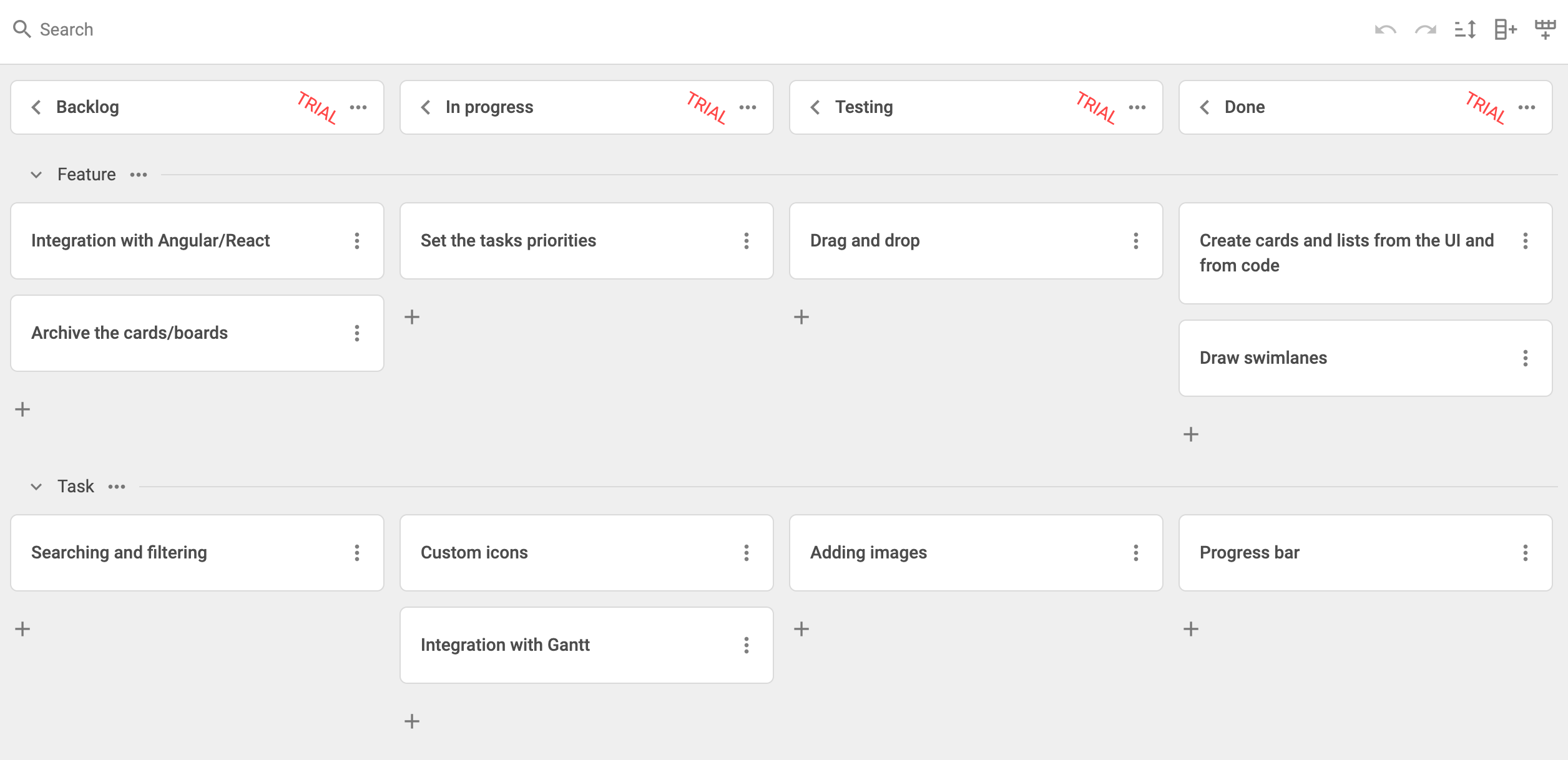
Run the app to view the populated Kanban board on the page.
See the complete project on GitHub.